The same work, done a different way every time, isn't a training problem.
A process nobody has mapped can't be standardized, automated, or made ready for AI.
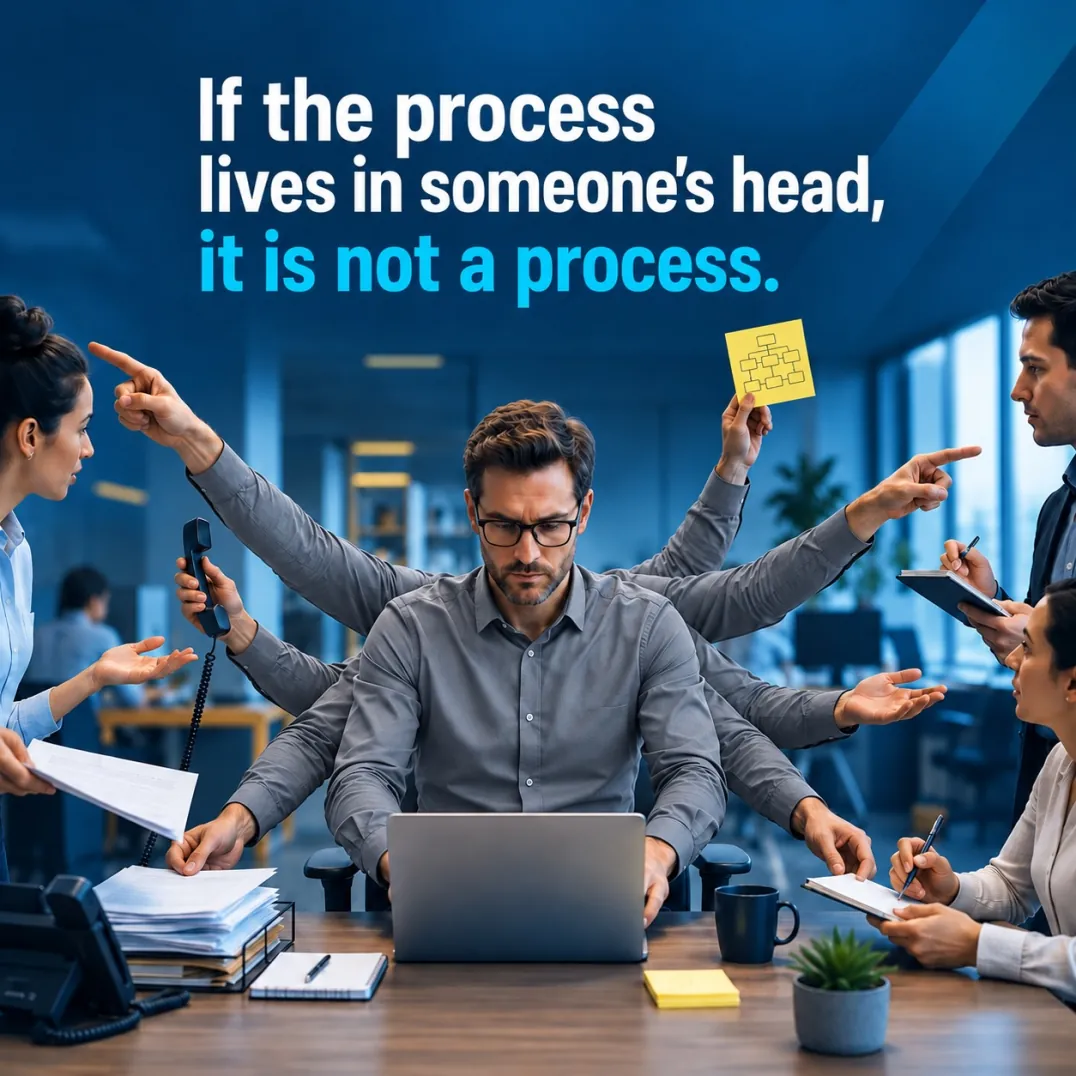
Operational inconsistency is what happens when the same work is performed differently by different people, teams, or locations because the process was never documented in the first place. It shows up as variable quality, slower onboarding, and harder cross-training, and it is usually a documentation and ownership problem, not a training problem.
What Causes Operational Inconsistency?
Most operational inconsistency isn't the result of anyone doing something wrong. It happens gradually: a process was never formally documented, so each team, location, or new hire fills in the gaps with their own judgment. Years later, the "same" process is really a dozen different processes wearing the same name.
Because nothing was written down, there's no shared baseline for anyone to check their version against, so each variation feels just as correct as the last, and nobody is in a position to say which one, if any, is actually right.
Common Symptoms
- The same task is completed differently depending on who is doing it or which office they're in.
- Quality or output varies noticeably across teams, shifts, or locations doing ostensibly the same job.
- New hires learn "how we really do it" informally from whoever happens to train them.
- Leadership can't say with confidence what the standard process actually is for a given task.
- Improvement efforts stall because there's no agreed-upon current-state process to improve from.
- Processes break down when key people leave, rather than smoothly transitioning.
Why It Matters
Inconsistency creates compounding costs: quality variation, compliance and safety exposure, harder cross-training, and slower onboarding, because every new hire is learning a slightly different version of the job depending on who trains them. It also makes improvement nearly impossible: you can't standardize, automate, or AI-enable a process that no one has actually mapped.
Operational inconsistency is rarely solved by more training. Training reinforces whatever process someone happens to be taught, inconsistency and all. It's solved by documenting how the work actually happens, deciding what "correct" looks like, and giving people something concrete to follow.
How Glymr Helps
Glymr maps how work actually gets done, including the workarounds and exceptions that determine real-world outcomes, and helps organizations agree on a standardized process that people can actually follow. Where the rules that decide the right answer were never written down (the exceptions, the edge cases, the reasons behind them), Critical Knowledge Capture documents them, so the standard is built on how the work actually runs rather than on someone's best recollection. Where the resulting standard needs a permanent home, Knowledge Management Programs turns it into documentation, training material, and a governance model that keeps it current.
What Fixing This Looks Like
70% faster chat response, inquiries resolved 2.3x faster.
Nubank's support copilot combines the company knowledge base with conversation history to give agents consistent suggested responses, summaries, and step-by-step guidance instead of each agent working from memory. The result: a 70% reduction in chat-response time and inquiries resolved 2.3 times faster.
OpenAI Customer Story, "Nubank elevates customer experiences with OpenAI"40% fewer design hours, 70% fewer dev hours, 17% fewer test hours.
Simplex deliberately applied AI to a shared, documented set of design artifacts, reference implementations, requirements, and test criteria rather than letting teams develop isolated local practices. Standardizing that workflow cut design hours by 40%, development hours by 70%, and internal integration-testing hours by 17%.
OpenAI Customer Story, "Simplex rethinks software development with Codex"8,000+ employees, 2M+ questions asked of a trusted internal assistant.
Telstra grounded its frontline knowledge assistant, Ask Telstra, in trusted corporate information rather than leaving each employee to rely on whatever documentation they happened to find. More than 8,000 employees have asked it over two million questions, saving agents more than a minute per customer call on average.
Telstra, "How Telstra is building AI capability across its workforce""Our partnership with Glymr has had a positive impact on our organization. Glymr's expertise has boosted the productivity of our Business Intelligence (BI) team. This has enabled us to better understand our complex data and begin to unlock its full potential. Their methodical approach to knowledge management and analytics has allowed us to gain deeper insights into our operations. Beyond the BI team, Glymr's impact is now extending into other departments within our enterprise. Their efforts to document business processes have been key to finding opportunities to automate or optimize business functions. The standardization and optimization of processes, coupled with our enhanced reporting, is leading to measurable value, reinforcing our strategic goals and optimizing operational functions."
Related Reading
Operational inconsistency often traces back to expert bottlenecks: the informal workarounds a few experienced employees carry that never made it into a documented process.
Find out where the same work is being done a different way.
A Knowledge Friction Assessment identifies where execution varies across teams, locations, and shifts, and what that inconsistency is costing in quality and rework.
Frequently Asked Questions
How do you standardize business processes across teams?
By first mapping how the work actually happens today, including the workarounds and exceptions each team has developed, and then helping the organization agree on a standardized process that people can actually follow. Skipping straight to a written standard without mapping current-state reality is why many standardization efforts do not stick.
Why do employees follow different processes for the same work?
Usually because the process was never formally documented in the first place, so each team, location, or new hire filled in the gaps with their own judgment. Over time, the same process becomes several different processes wearing the same name, not because anyone did something wrong, but because nothing was written down to keep it consistent.
How can process mapping improve operational consistency?
Process Mapping documents how work actually happens, including the exceptions and workarounds that determine real outcomes, which gives an organization something concrete to standardize from. You cannot standardize, automate, or AI-enable a process that no one has actually mapped.
Does more training fix operational inconsistency?
Not on its own. Training reinforces whatever process someone happens to be taught, inconsistency and all. Operational inconsistency is solved by documenting how the work actually happens, deciding what correct looks like, and giving people something concrete to follow, not by training harder on an undocumented process.