Identify
Turn AI adoption into AI effectiveness.
Your employees may already be using AI every day. The AI Effectiveness Assessment measures how much of that usage is producing useful work, and identifies the knowledge, business context, governance, capability, and workflow barriers creating friction, rework, and unrealized value.
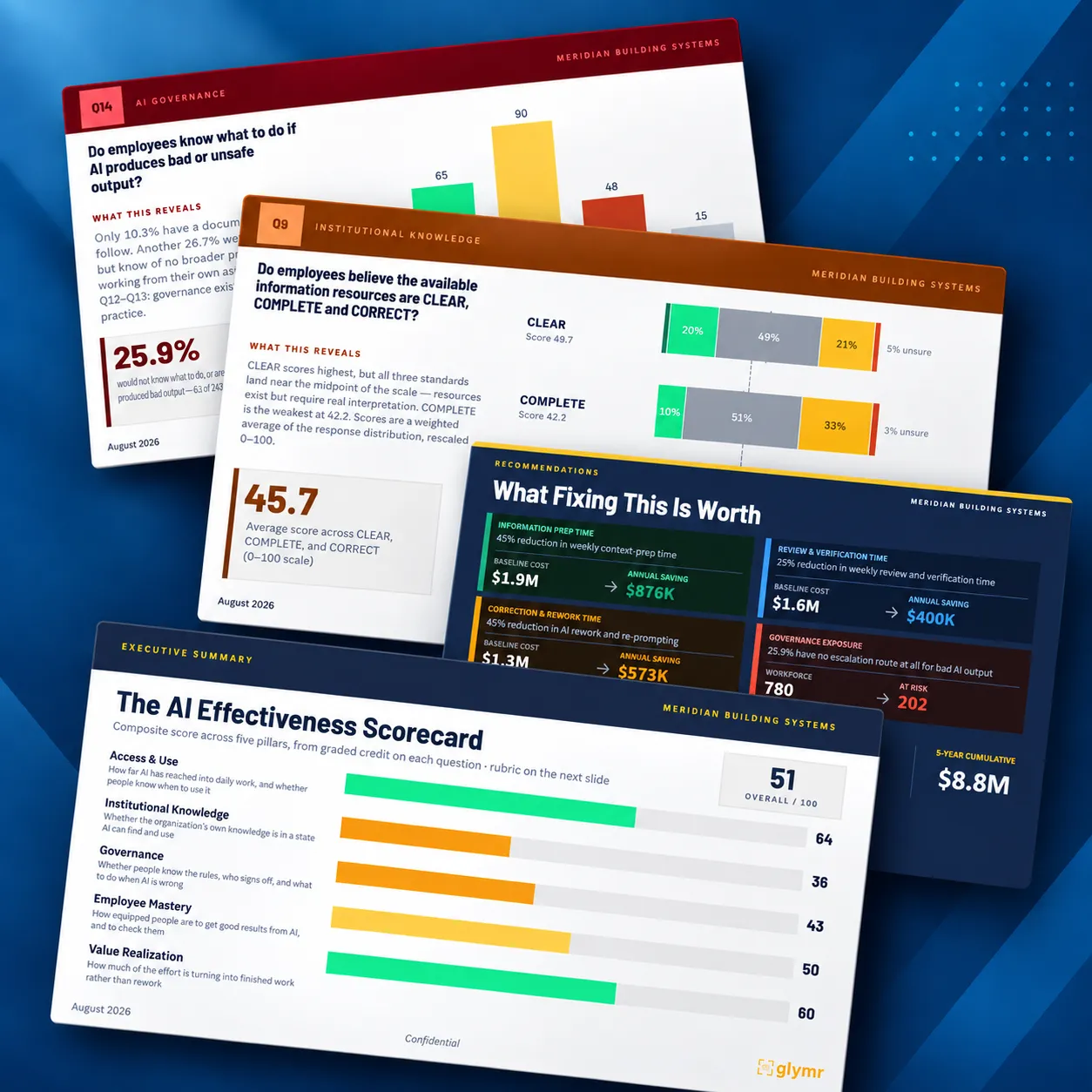
The AI Effectiveness Assessment measures how effectively employees are turning AI into useful work, and identifies the organizational knowledge, business context, governance, capability, and workflow barriers that limit the value of the AI your organization has already adopted.
Why This Matters
Most organizations can already tell you how many people have Copilot licenses, how many employees use ChatGPT, or how many prompts run each month. Far fewer can tell you how much of that AI time is productive, and how much is consumed by finding context, explaining how the business works, checking outputs, correcting results, and redoing work the AI got wrong.
AI adoption is not the same as AI effectiveness. An organization can have widespread AI access and heavy employee usage while still losing significant value, because employees cannot easily find the information AI needs, cannot tell which information is authoritative or current, spend substantial time reviewing and re-prompting, or abandon AI-assisted tasks when the results are not good enough. Traditional adoption metrics do not reveal that friction. This assessment does.
What the Assessment Measures
The assessment examines several connected dimensions of enterprise AI effectiveness, organized around a simple progression: Access → Context → Capability → Governance → Effectiveness. Every dimension is measured by asking employees directly about their own experience of using AI:
- AI access, use, and opportunity: current adoption, approved versus unapproved use, employee confidence about appropriate use, and where employees see unrealized potential
- AI-ready knowledge and business context: whether employees can reach knowledge that is clear (the authoritative source can be identified), complete (the necessary context is there), and correct (current, and not contradicted by competing versions), and whether documentation captures business context, operating logic, and hard-won lessons
- AI governance: whether employees understand approved tools, appropriate information use, review requirements, accountability, and what to do when AI produces problematic output
- Employee AI mastery and support: training, the ability to give AI useful context and to evaluate its output, and access to examples, reusable practices, and knowledgeable help
- AI value and friction: how much AI time translates into productive work versus preparation, verification, correction, rework, or abandoned attempts
What You Receive
- An AI effectiveness findings summary, including where AI is creating value and where employee time is being lost to friction and rework
- A prioritized list of the knowledge, context, capability, and governance barriers limiting value
- Governance and ownership recommendations
- A sequenced set of targeted improvements to increase useful output per hour employees spend working with AI
Here are a few pages from a sample assessment report:
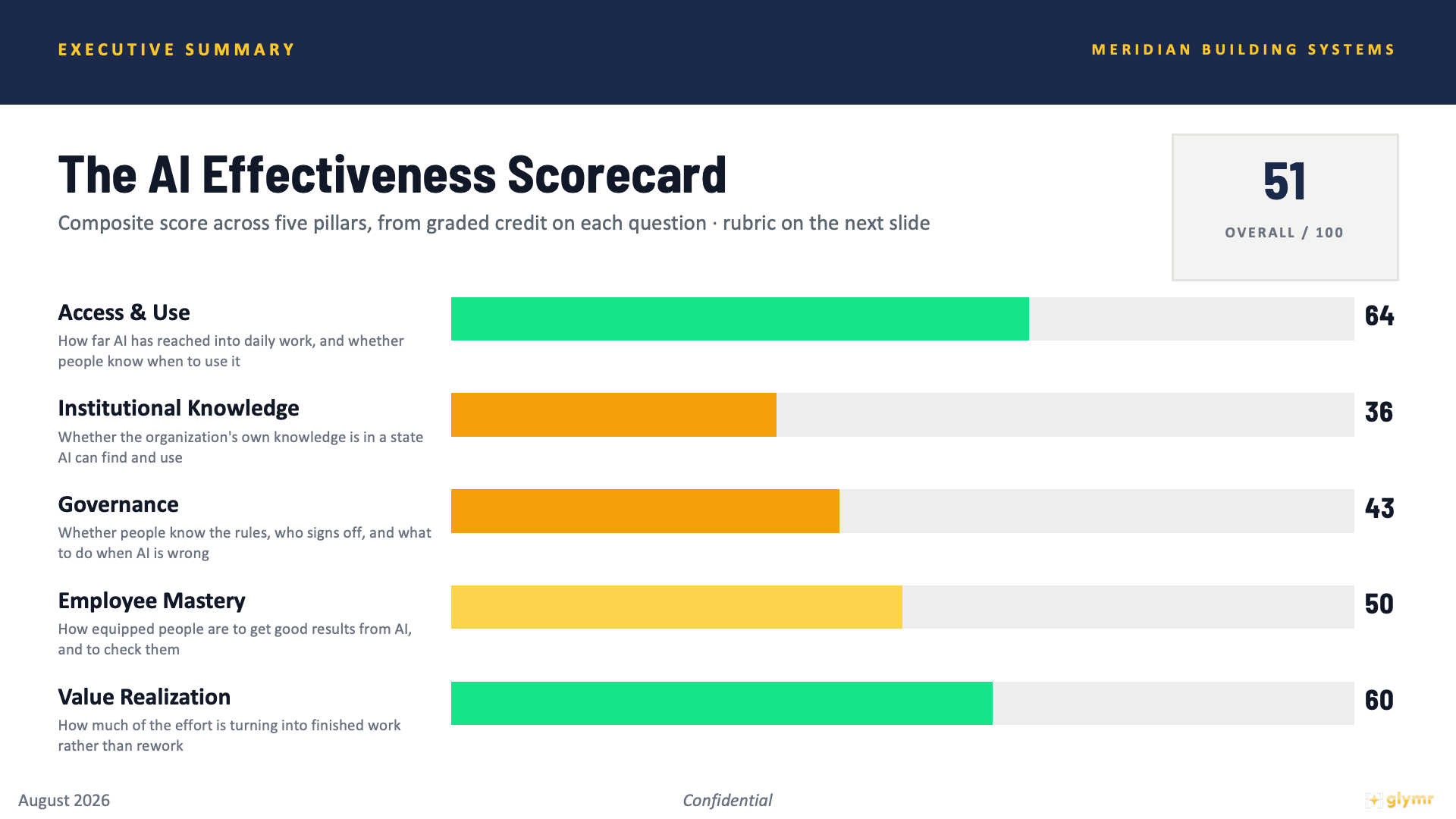
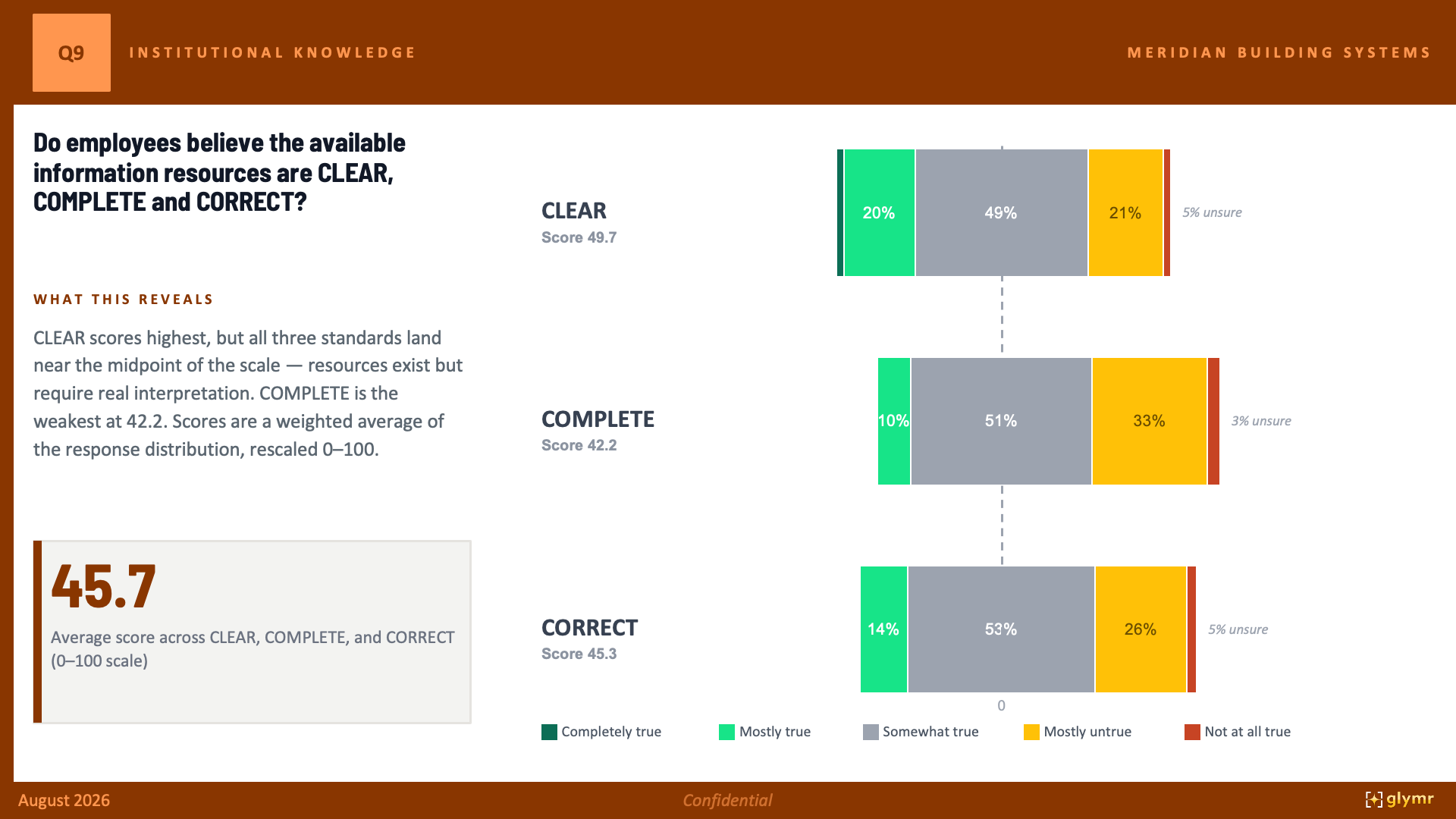
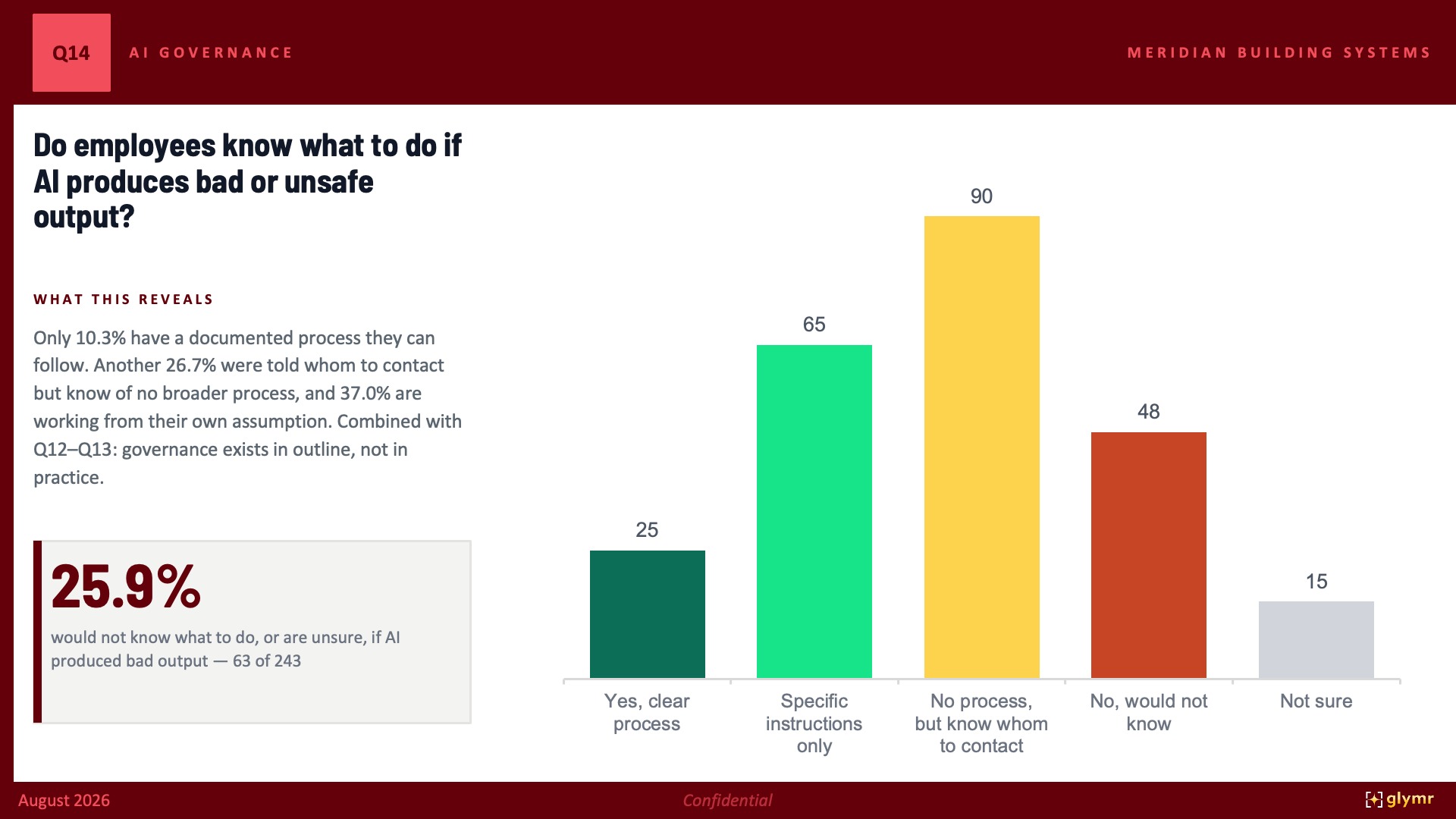
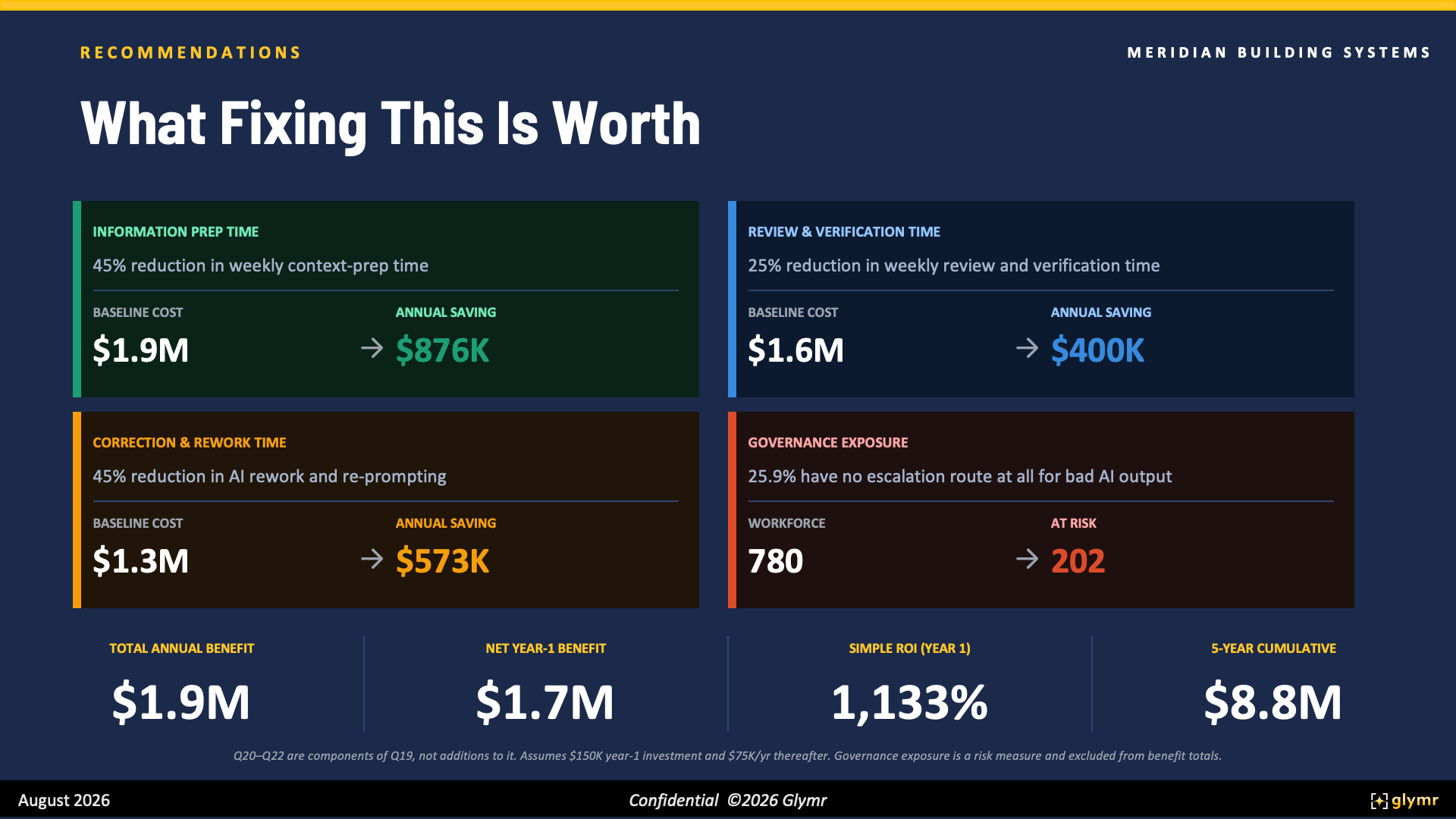
Pages shown are based on simulated data for a fictional company.
Involvement
Low Commitment, Light Lift, Maximum Value
The assessment measures what your employees actually experience when they use AI, so it asks them directly. That keeps the lift small.
- About two weeks from launch to readout, depending on how quickly responses come in
- Roughly 10 minutes per employee to complete the survey
- 10–12 questions from you about the organization: headcount, locations, average salary, and similar context
- Help getting the survey out (your HR team sends it, or you give us a list) plus a reminder or two while it runs
- One to two hours from you and your leadership team for the readout
Fixed fee, agreed before we start. No instrumentation to install, no integration work, and nothing to connect to your AI tools: the findings come from the people using them.
Who This Is For
The AI Effectiveness Assessment is most valuable when:
- Employees are already using AI regularly enough that there is real work to look at, not a pilot, a policy, or licenses that have barely been opened.
- Adoption numbers are rising and leadership cannot explain why the productivity gains have not followed.
- People are spending real time feeding AI context, checking its output, and redoing work it got wrong, and no one has sized that time.
- Results vary widely between teams using the same tools, and no one can say what the effective users are doing differently.
- The board is asking what the AI investment has delivered, and leadership wants an answer grounded in what employees actually experience rather than vendor dashboards and anecdote.
If your organization is still selecting tools or has only just started rolling them out, a Knowledge Friction Assessment is the better starting point; it examines the knowledge and process conditions that determine whether AI will work once you do deploy it.
What This Is Not
This is not an audit of AI infrastructure, model architecture, cloud capacity, data science capability, or vendor and model selection. Those may matter to a broader AI maturity review; they are not the focus here. AI maturity tells you how developed your AI program is. AI effectiveness tells you whether employees can convert those capabilities into useful work. This assessment answers the second question, from the employee and workflow level.
Related Reading
See how Glymr's AI & Process Adoption Support service builds on assessment findings to close the gaps between AI access and useful work, and AI Readiness & Adoption for why access to AI tools and data is not enough on its own.
Find out how much of your AI usage is turning into useful work.
About two weeks from launch to readout, roughly 10 minutes per employee, and a clear read on the knowledge, context, governance, and capability gaps limiting the value of the AI you have already deployed.