Undocumented knowledge doesn't stay hidden. It shows up in the deal.
Knowledge risk affects diligence readiness, valuation, integration speed, and post-close performance, on both sides of the transaction.
M&A knowledge risk is the exposure created when critical operating knowledge (processes, systems, customer context, decision history) is undocumented, concentrated in a few people, or lost during a transaction. It slows diligence, weakens valuation, and undermines post-close integration.
What Causes M&A Knowledge Risk?
That risk builds up long before a deal is ever on the table. Businesses document what keeps daily operations running, not what a future buyer might need to see, so the reasoning behind a pricing exception, the history behind a key relationship, or which systems are actually still critical never gets written down, because day-to-day that knowledge was always good enough. Diligence then puts the business on a compressed timeline where there's no time left to track down the person who knows.
Common Symptoms
- Due diligence responses require extensive manual reconstruction because core processes were never documented.
- Buyers can't get a clear picture of technology ownership, dependencies, or which systems are actually still in use.
- Key employees (the ones who understand pricing logic, client relationships, or how a system really works) are flight risks during and after the deal.
- Post-close integration stalls because acquired teams operate differently and no one has mapped how.
- A price point, contract term, or operating assumption that mattered to the deal's value was never written down anywhere.
Both sides of the table
Why It Matters
Knowledge gaps in M&A are rarely discovered in time to prevent damage: they surface as retention problems, integration delays, or valuation surprises after the deal is already closed. A company can lose a large share of acquired deal value simply because no one understood why customers were loyal to the business being bought, or what specific commitments were made and never documented.
The exposure isn't symmetrical in how it shows up, but it lands on both parties. A seller pays for it in delay and suppressed valuation, before the deal is ever signed and even when the underlying business is sound. A buyer pays for it after close, when the people who knew are already gone.
"Originally all of the leadership flowed through the founder. When he stepped down, tribal knowledge was lost and we had to spend the next two and a half years proving that the organization was stable without him before selling it."
"We didn't realize the amount of knowledge transfer that had to happen when we took over the business and the sellers left. … We gave them some incentive to stick around for a bit, but grossly underestimated what was necessary in the hand-off and the transition."
Executive interviews conducted under anonymity for Knowledge Management for Mergers & Acquisitions (Greenhouse & Hencke, 2024).
How Glymr Helps
Glymr helps both buyers and sellers reduce knowledge risk across the deal lifecycle. Data Landscape Mapping gives an accurate picture of the systems, data, and dependencies that actually shape how a business runs, essential for diligence and integration planning alike. Executive Knowledge Transfer structures the handoff of decision context and relationships when leadership changes hands. Process Mapping documents how work actually happens so integration teams aren't guessing. Where the risk centers on capturing a specific individual's expertise before a transition, that capture work is scoped directly into the relevant engagement.
What Fixing This Looks Like
$120M/yr in benefits, margins 7% to 24%, from a repeatable acquisition-knowledge system.
CEMEX turned post-merger integration into a repeatable knowledge-transfer system, capturing and benchmarking practices from each acquisition and routinely adding 15–30 acquired practices to its enterprise standards. In its Spanish acquisitions, transferring operational knowledge contributed to $120 million in annual benefits and an increase in operating margins from 7% to 24%.
MIT Sloan School of Management, CEMEX case study57% vs. 15% cross-legacy ties tracked with unit performance.
In one global consumer-products merger, the highest-performing business unit had 57% of its collaborative relationships crossing legacy-company boundaries, versus only 15% in the unit with the slowest post-merger revenue growth. Mapping informal networks and beliefs helped leaders identify the local influencers needed to close the gap, the kind of relationship the org chart and data room never show.
Connected Commons, "Using Network Analysis to Accelerate Merger Integration"Near-100% retention of acquired employees via a repeatable integration system.
Cisco built a centralized, repeatable acquisition-integration system designed to capture best practices and reuse expertise from one deal to the next. Cisco reported retaining nearly 100% of acquired employees who transitioned into the company during the first two years following an acquisition.
Cisco IT Case Study, "Acquisition Integration"Related Reading
M&A knowledge risk is closely related to Critical Knowledge Risk, the broader exposure created when essential knowledge depends on too few people.
Go Deeper
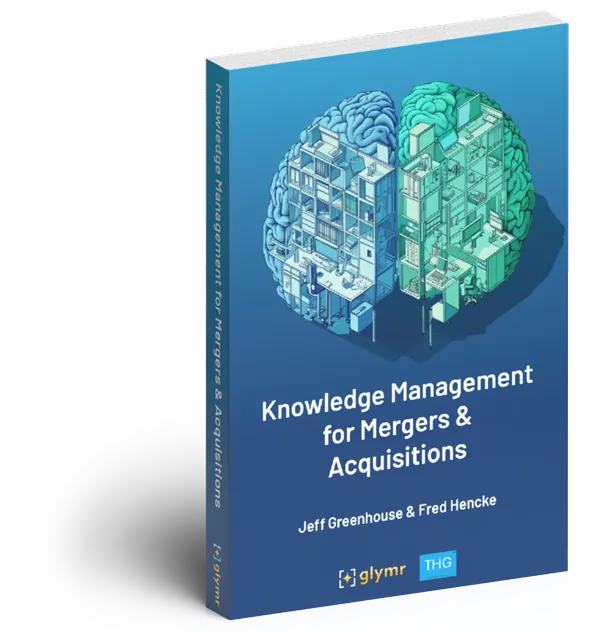
Free Ebook — Knowledge Management for Mergers & Acquisitions: a stage-by-stage look at how knowledge management improves deal selection, due diligence, valuation, and post-deal integration, with insights from seven executive interviews and real M&A case studies. Get the ebook →
Know what the knowledge risk is before it shows up in the deal.
A Knowledge Friction Assessment gives buyers and sellers a quantified read on undocumented processes, key-person dependency, and integration exposure. Two weeks, start to finish.
Frequently Asked Questions
How does knowledge management support M&A integration?
By giving integration teams an accurate picture of how the acquired business actually operates instead of guesswork. Glymr's Data Landscape Mapping shows the systems, data, and dependencies that shape how the business runs, and Process Mapping documents how work actually happens, both essential inputs for planning integration rather than discovering problems after close.
What knowledge risks should buyers evaluate during diligence?
Whether core processes were ever documented, whether technology ownership and dependencies are clear, and whether key employees who understand pricing logic, client relationships, or critical systems are flight risks during and after the deal. Undocumented answers to these questions tend to surface later as retention problems, integration delays, or valuation surprises.
What should be captured before a merger or acquisition closes?
The decision context and relationships a departing or transitioning leader carries, and any pricing logic, contract terms, or operating assumptions that mattered to the deal's value but were never written down. Glymr structures this through Executive Knowledge Transfer and scopes specific expert knowledge capture directly into the relevant engagement.
Why do post-merger integrations fail because of knowledge gaps?
Because acquired teams operate differently than the buyer expects, and no one has mapped how, so integration stalls while teams try to reconcile processes that were never documented on either side. The same undocumented-knowledge risk that slows diligence tends to resurface during integration if it was not addressed beforehand.