Make it Usable
Knowledge Management Programs That Make Internal Knowledge Usable
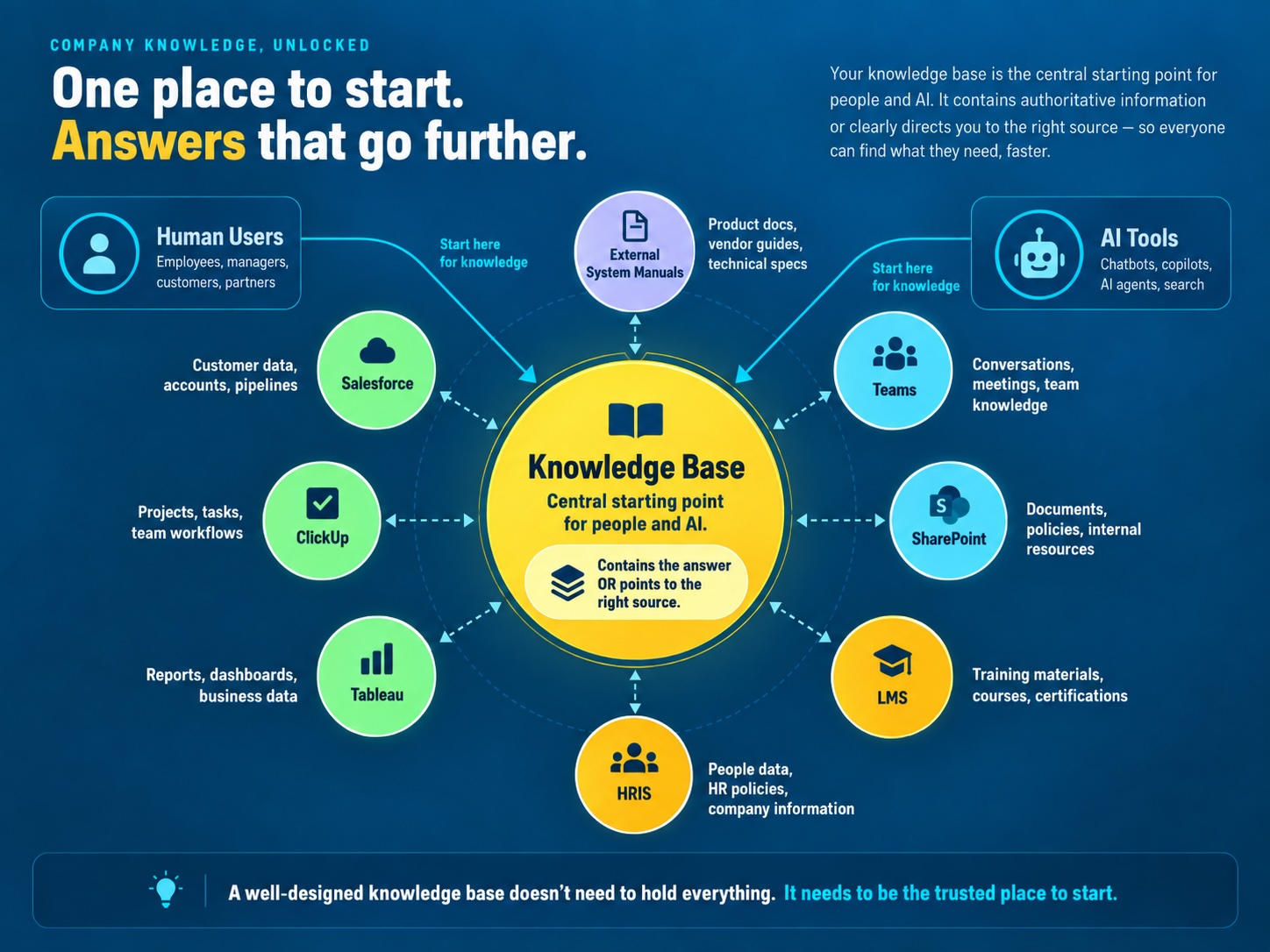
Glymr designs the strategy, knowledge architecture, documentation, governance, training, and adoption systems required to turn scattered institutional knowledge into a resource employees and AI tools can reliably use.
A Knowledge Management Program is Glymr's service for turning scattered institutional knowledge into a structured, governed resource that employees and AI tools can reliably use, combining knowledge strategy, information architecture, documentation standards, critical knowledge capture, governance, training, and adoption support into one coordinated engagement rather than a series of disconnected projects.
Why This Matters
Knowledge-base design, documentation, and governance are usually treated as separate initiatives: a platform project here, a documentation push there, a governance policy no one enforces. Clients experience these as parts of one problem, not three. Deciding what to document, organizing it so people can find it, and keeping it accurate and owned are interdependent: getting one wrong undermines the other two.
Most knowledge programs fail for the same reasons: no one decided what actually needed to be documented, the structure didn't match how people search and work, or no one owned it after launch. Once employees stop trusting a knowledge system, they stop using it, and it's rarely rebuilt without deliberate redesign.
"Initially hesitant due to concerns about time constraints and team adoption, Jeff's guidance was instrumental in seamlessly integrating the new system into our daily operations. Glymr not only provided a solution that was tailored to our specific needs but also ensured its successful adoption through an engaging onboarding process and creative strategies that encouraged team involvement."
What Glymr Does
- Knowledge strategy: identifies which knowledge is worth documenting and which isn't, based on friction and risk, so effort goes toward what actually matters
- Knowledge-base and information architecture: audits existing content and designs a structure aligned to how employees actually search and work
- Documentation standards and templates: defines the right level of detail, format, and audience for each content type
- Critical knowledge capture and initial content development: captures the expertise, exceptions, decision logic, and operating context that employees and AI tools need to perform work reliably, and builds the first wave of content
- Platform selection and configuration guidance: helps select and configure the right tools within an organization's existing environment (Confluence, SharePoint, Teams, Slack, Jira, and related platforms)
- Governance, ownership, and review workflows: assigns content ownership and an update cadence so the program doesn't go stale
- Editor and employee training: prepares the people who will own and maintain the system
- Adoption support: supports rollout so the program actually gets used, not just launched
- Measurement and continuous improvement: tracks usage and accuracy so the program keeps working after launch
- AI-ready preparation: structures and governs content so it can be reliably used by AI-supported search, copilots, and agents, not just by employees
Some Glymr Client Results
Who This Is For
Knowledge Management Programs are most valuable for:
- Organizations with a knowledge base that exists but isn't trusted or used
- Companies consolidating knowledge scattered across email, drives, and chat
- Teams preparing their knowledge environment as a foundation for AI search and copilots
- Agencies and professional services firms standardizing client and delivery knowledge
- Fast-growing companies outgrowing informal, ad hoc documentation
- Organizations that have tried "document everything" initiatives that stalled or went unused
"…they implemented a Confluence-based knowledge management system that aligned departments, increased accountability, and streamlined collaboration. While we have work ahead, our teams now move with greater speed, coordination, and confidence."
Related Reading
A well-structured Knowledge Management Program is also the foundation required for AI & Process Adoption Support: AI tools can only be as reliable as the knowledge underneath them, and adoption support helps employees put the resulting program to work in real day-to-day tasks.
Turn scattered knowledge into something people actually use.
A short call to scope a Knowledge Management Program. If you would rather start by measuring where the friction is worst, a Knowledge Friction Assessment is the shorter first step.
Frequently Asked Questions
What is knowledge-base design?
Knowledge-base design is the work of organizing an organization's documented knowledge so employees can actually find it, auditing existing content and structuring it around how people search and work rather than how a department happens to store files. At Glymr, it is one integrated part of a Knowledge Management Program, not a standalone platform project.
What is a documentation strategy?
A documentation strategy defines what should be captured, for whom, and in what format, including the level of detail, structure, and audience for each type of content. Glymr treats documentation strategy as inseparable from knowledge-base design and governance, since deciding what to document only works if it is organized for how people search and someone owns it afterward.
What is knowledge governance?
Knowledge governance is how documented knowledge stays accurate, current, and trusted after it is created, assigning ownership and a review cadence so a knowledge base does not go stale. Glymr builds governance, ownership, and review workflows into every Knowledge Management Program rather than treating governance as a policy no one enforces. See How to Build a Knowledge Governance Model for the six parts of a working model.
What is critical knowledge capture?
Critical knowledge capture is the work of documenting the expertise, exceptions, decision logic, and operating context that live in people's heads rather than in any system, the knowledge employees and AI tools need to perform work reliably. It is a core component of Glymr's Knowledge Management Programs, is available as a standalone engagement through Critical Knowledge Capture, and also shows up in Knowledge Exit Interviews and Executive Knowledge Transfer when that knowledge is at risk of leaving with a specific person.
Who is a Knowledge Management Program for?
It is built for organizations with a knowledge base that exists but is not trusted or used, companies consolidating knowledge scattered across email, drives, and chat, teams preparing their knowledge environment for AI search and copilots, agencies and professional services firms standardizing client and delivery knowledge, and fast-growing companies that have outgrown informal documentation.
How is a Knowledge Management Program different from a documentation project?
A documentation project usually treats writing content as the whole job. A Knowledge Management Program treats documentation as one of three interdependent pieces, what gets captured, how it is structured so people can find it, and who keeps it accurate afterward, because getting one piece right while ignoring the other two is why most knowledge programs stall or go unused.