AI doesn't fix fragmented knowledge. It exposes it.
Access to AI tools and company data is not enough on its own. AI is only as reliable as the knowledge, process clarity, and governance underneath it.
AI readiness is whether an organization's knowledge, processes, and business context are structured and governed well enough for AI tools to produce reliable, trustworthy output. Most companies that give employees AI access without addressing the knowledge underneath it get inconsistent results, not transformation.
What Causes AI Readiness Gaps?
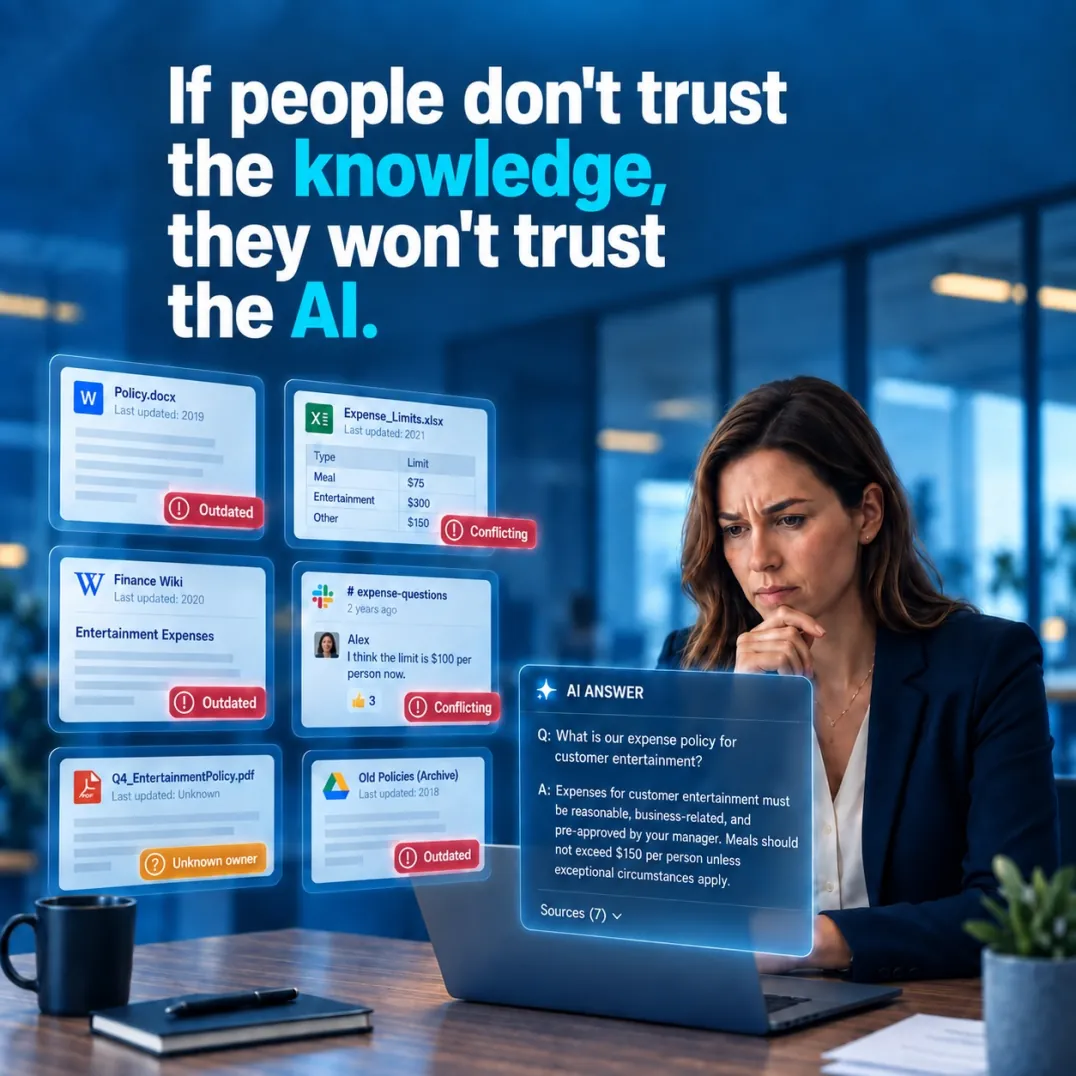
This gap opens because AI rollout and knowledge work get planned as two separate projects. A tool gets licensed, employees get access to company systems, and the assumption is that the AI will sort out what's reliable on its own. It can't; it has no way to tell a current process from an outdated one, or a documented exception from one that only ever lived in someone's head, so it treats everything it's given as equally trustworthy.
Common Symptoms
- Employees get inconsistent or unreliable answers from AI tools connected to internal data.
- Teams spend significant time re-prompting, correcting, or double-checking AI output before they trust it.
- No one can say clearly which workflows are actually ready for AI and which are not.
- AI initiatives stall after a promising pilot because the knowledge foundation underneath was never addressed.
- Different employees get different answers to the same question from the same AI tool, because the underlying source knowledge is inconsistent.
Why It Matters
AI does not solve fragmented knowledge and unclear processes. It exposes them, often publicly and at speed. A copilot trained on outdated documentation will confidently produce outdated answers. An agent built on top of undocumented exceptions will miss them every time. The organizations getting real value from AI are the ones that treated knowledge and process clarity as a prerequisite, not an afterthought.
"Agents are only as useful as the authoritative data they have access to."
Aaron Levie, co-founder and CEO, BoxThis is also where Glymr draws a firm boundary: preparing knowledge, process, and governance for AI is different work from building AI models, agents, or platforms. Glymr does not implement AI systems or serve as a systems integrator.
How Glymr Helps
Glymr's AI Effectiveness Assessment measures how effectively employees are turning AI into useful work and identifies the knowledge, business context, capability, and governance barriers limiting greater value from the AI already in use. Where the business context AI needs exists only in people's heads or inside systems nobody documented, Critical Knowledge Capture documents those business rules, exceptions, and decision logic so there is something reliable for AI to draw on. From there, Glymr builds the knowledge architecture, documentation, and governance AI systems need through Knowledge Management Programs, and helps employees put AI-supported work into practice through AI & Process Adoption Support.
What Fixing This Looks Like
4 months of M365 cleanup before scaling Copilot to 20,000 users.
Before scaling Microsoft 365 Copilot to approximately 20,000 users, Kyndryl spent four months cleaning and governing its Microsoft 365 knowledge environment: tightening access, retiring roughly 20,000 inactive SharePoint sites, and classifying content. The company later reported that 94% of users received at least 20 minutes of daily task assistance.
Kyndryl, "5 best practices for implementing Copilot for Microsoft 365 at scale"75% lower AI cost per conversation from retrieval scoping.
Aydem Energy's customer-service assistant originally had access to its entire knowledge base, driving up cost and exposing the system to irrelevant context. After classifying customer scenarios and limiting retrieval to the knowledge library relevant to each one, Aydem cut AI cost per conversation by 75%.
Microsoft Customer Story, "Aydem Energy manages multiple-fold seasonal call surges with an AI-powered digital assistant"Radio-Canada trained 100+ newsroom staff and turned AI uncertainty into hands-on experimentation.
Radio-Canada paired foundational AI training with a biweekly cross-functional expertise group and hands-on "prompt clinics" where journalists built their own AI-assisted tools. More than 100 staff across TV, radio, and web completed training, and the effort produced an internal prompt library and an AI-generated news-summary feature.
Online News Association, "Case Study: Building AI Literacy at Canada's National Public Broadcaster Radio-Canada"Bad Knowledge Casts a Long Shadow
In a 2026 TrustNLP study, researchers gave AI models questions along with source material that contained both the correct information and a flawed passage, such as an outdated version of the same fact. Some answers drew on the flawed passage even though the correct information was right there. The researchers then ran the same questions again with only the flawed passage hidden, leaving the correct information in place. That one change resolved 95.5% of the errors they had detected.
Keeping AI accurate means retiring outdated knowledge, not just publishing the corrected version.
Related Reading
See how Knowledge Management Programs build the AI-ready foundation this page describes, and how AI & Process Adoption Support helps employees actually use it. For the ownership, review, and retirement routines that keep AI's source knowledge current, see How to Build a Knowledge Governance Model.
Find out how much of your AI usage is turning into useful work.
An AI Effectiveness Assessment measures where employee AI time actually goes: doing work, preparing context, verifying output, or redoing it. It identifies the knowledge and governance gaps limiting the value.
Frequently Asked Questions
Why is access to company data not enough for AI?
Because AI systems reproduce whatever knowledge they are given, including scattered, outdated, or untrusted information, faster and with more apparent confidence than a person would. Connecting AI tools to company data does not fix knowledge that was already unreliable; it just makes the unreliability more visible, and faster.
What business context does AI need to produce reliable output?
AI needs clear, current knowledge, process definitions, decision context, and governance to work from. Without that foundation, employees get inconsistent answers, spend time re-prompting or double-checking output, and cannot tell which workflows are actually ready for AI and which are not.
How do undocumented processes affect AI output?
An AI system built on top of undocumented exceptions will miss them every time, and a copilot trained on outdated documentation will confidently produce outdated answers. Undocumented processes do not just slow employees down, they get baked into whatever the AI produces.
Which business workflows are ready for AI?
It depends on whether the knowledge and process definitions behind that workflow are clear, current, and governed. Glymr's AI Effectiveness Assessment evaluates an organization's knowledge, business context, employee capability, governance, and workflow to show where AI-assisted work is already producing value and where targeted improvements are needed first.
How should companies prepare internal knowledge for AI?
By treating knowledge and process clarity as a prerequisite for AI, not an afterthought, starting with an AI Effectiveness Assessment to find where AI usage is being lost to friction and rework, then building the knowledge architecture, documentation, and governance AI systems need through a Knowledge Management Program.
Does Glymr build or implement AI systems?
No. Glymr prepares the organizational knowledge, process context, and governance foundation that determines whether AI produces reliable output. Glymr does not build AI models, agents, or platforms and does not serve as a systems integrator; that is different work from what Glymr does.