New hires shouldn't have to learn your business by trial and error.
When critical process knowledge isn't documented, new employees take months to reach full productivity, and the burden of getting them there falls on managers and senior staff.
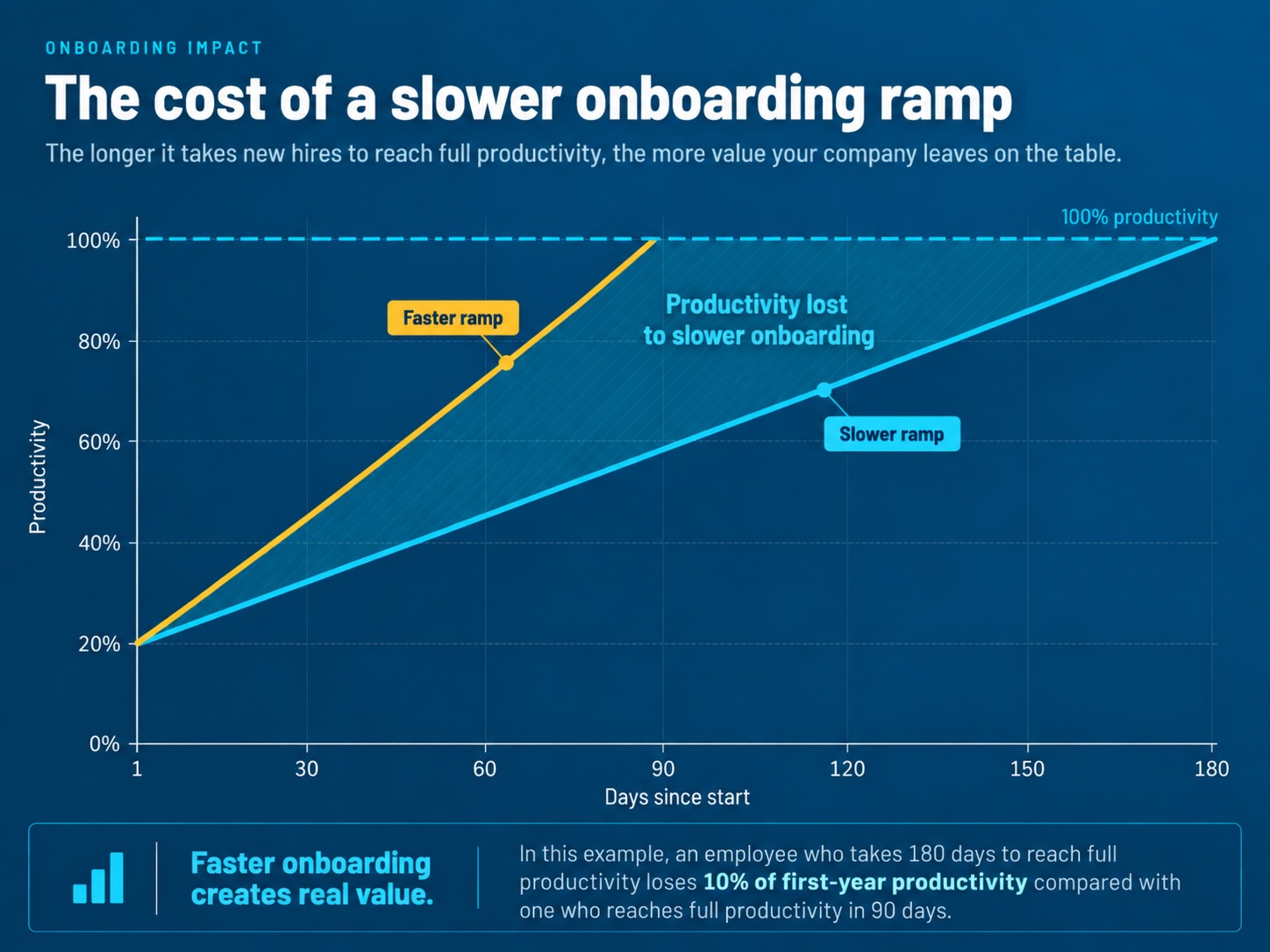
Slow onboarding and long ramp time are usually a knowledge problem, not a training-program problem. When the knowledge a new hire needs isn't documented anywhere trustworthy, they learn by trial and error, repeated questions, and informal mentoring, which takes far longer than it should and burns manager and expert time in the process.
What Causes Slow Onboarding?
Most onboarding programs cover the basics (org charts, benefits, tool access) but stop short of the knowledge a new hire actually needs to do the job well: how work really gets done, which exceptions matter, who owns what, and what "good" looks like. Without that, new employees spend their first months piecing together an understanding that a documented knowledge base could have given them on day one.
Common Symptoms
- New hires take months, not weeks, to reach full productivity.
- Managers spend a disproportionate amount of their own time answering the same onboarding questions for every new hire.
- Ramp time varies wildly depending on which manager or mentor a new employee happens to get.
- Internal transfers and promotions face the same ramp-up problem as external hires, because process knowledge was never documented for any role.
- New employees are pointed toward senior staff for answers that should be self-serve.
Why It Matters
Slow onboarding is expensive in ways that are easy to underestimate: lost productivity during ramp-up, manager time diverted from their own work, inconsistent quality while new hires are still learning by trial and error, and higher early-tenure attrition when new employees feel unsupported. It also compounds: every new hire relearns the same lessons the last one did, because nothing was captured along the way.
How Glymr Helps
Glymr's Knowledge Friction Assessment identifies where onboarding and ramp time are being slowed by missing or undocumented knowledge. From there, Glymr builds Knowledge Management Programs that give new hires a trustworthy, structured place to find what they need, reducing reliance on informal mentoring and repeated questions. Where a role transition involves a departing employee handing off to a successor, Executive Knowledge Transfer structures that handoff directly.
What Fixing This Looks Like
50% onboarding reduction with an AI-powered knowledge base.
Vxceed cut onboarding time by 50% with a centralized, AI-powered knowledge base that let new employees get instant answers without relying on manuals or peers.
AWS Case Study, Vxceed's LimoConnectQ appTraining time cut from 13 weeks to as little as 2.
Overture Partners reduced new-hire training from 13 weeks to as little as 2 weeks after centralizing 400+ internal documents into a searchable AI knowledge assistant.
CustomGPT.ai Case Study, Overture Partners30% faster onboarding.
Container Port Group reduced onboarding time by 30% after centralizing SOPs, policies, and tribal knowledge into a shared company playbook.
Waybook Case Study, Container Port GroupRelated Reading
Slow onboarding is often a symptom of the same root cause as expert bottlenecks: knowledge that exists only in people's heads instead of somewhere new hires can find it themselves.
Find out what is actually slowing your new hires down.
A Knowledge Friction Assessment measures ramp time against what is documented, and shows which missing knowledge costs new employees and their managers the most.
Frequently Asked Questions
How can knowledge management improve onboarding?
By giving new hires a documented, trustworthy place to find how work really gets done, which exceptions matter, who owns what, and what good looks like, instead of learning it through trial and error and informal mentoring. Glymr builds this through Knowledge Management Programs after identifying where onboarding is being slowed by missing knowledge.
How do you reduce new employee ramp time?
By documenting the knowledge new hires actually need beyond the basics covered in most onboarding programs, since org charts, benefits, and tool access do not tell someone how work really gets done. Glymr's Knowledge Friction Assessment identifies where ramp time is being slowed by missing or undocumented knowledge, and Knowledge Management Programs address it.
What knowledge should be documented for new hires?
How work really gets done, which exceptions matter, who owns what, and what good looks like for their role, the knowledge most onboarding programs skip in favor of logistics like org charts and tool access. The same gap slows down internal transfers and promotions, not just external hires.
Does slow onboarding always mean a bad training program?
No. Slow onboarding and long ramp time are usually a knowledge problem, not a training-program problem. When the knowledge a new hire needs is not documented anywhere trustworthy, they learn by trial and error and repeated questions no matter how well-designed the training program is.