Assess
Find out where knowledge friction is costing your organization.
The Knowledge Friction Assessment identifies, quantifies, and prioritizes where your organization is losing time, money, and operational capacity to hidden knowledge drag.
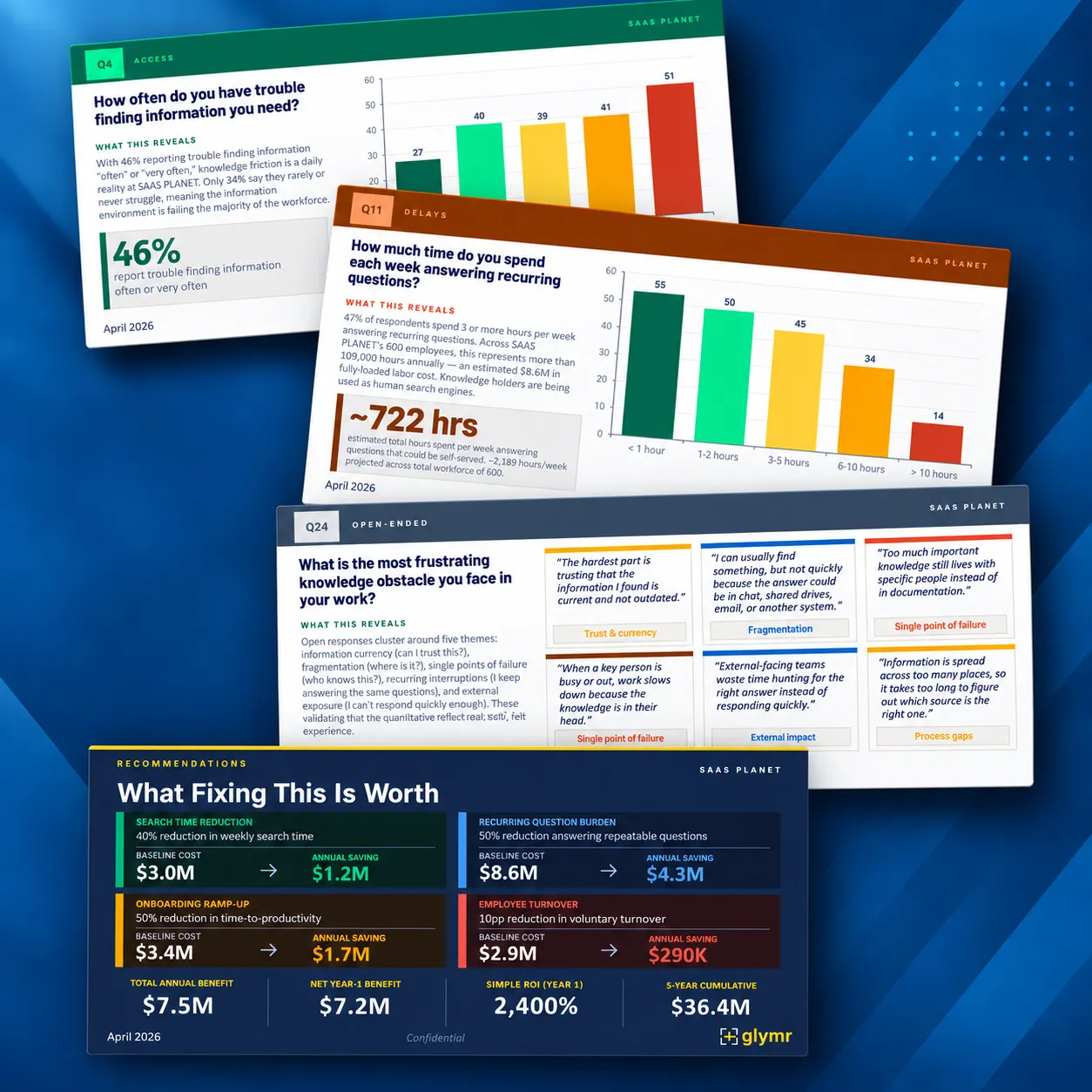
The Knowledge Friction Assessment is a fast, low-lift engagement: about two weeks from launch to readout, roughly 10 minutes per employee, and 10–12 questions plus a readout session from you. There is no discovery phase and no embedded consulting team. You end with a board-ready report that quantifies what knowledge friction is costing your organization and a prioritized set of recommendations that tells you what to fix first.
What the Assessment Measures
The Knowledge Friction Assessment examines seven dimensions of knowledge friction across your organization. Every dimension is measured by asking employees directly about their own experience of the work, so the findings size each problem and show which departments feel it most:
- Search time and repeated question burden: How much time do employees spend finding information or asking colleagues for answers that should be findable elsewhere?
- Expert dependency and key-person risk: How often does work stall waiting on a specific colleague, and how widely is that dependency felt across the organization?
- Onboarding and ramp-time friction: How long does it take new employees to reach full productivity, and what is slowing them down?
- Process inconsistency and undocumented workflows: How often do employees report the same work being done differently, or done with no documentation to follow, and which departments report it most?
- Knowledge loss exposure: How much of the work depends on knowledge that exists only in individual employees' heads, and what is the scale of the exposure if they leave?
- AI knowledge blind spots: Is your organizational knowledge structured well enough to support AI adoption?
- Prioritized recommendations and cost quantification: What should you address first, and what is the business case for doing so?
What You Receive
At the conclusion of the assessment, you receive a structured, board-ready report that includes:
- An inventory of your highest-friction knowledge areas
- Quantified cost estimates where data supports them
- Prioritized recommendations organized by impact and effort
- A roadmap for addressing the highest-priority gaps
Here are a few pages from a sample assessment report:
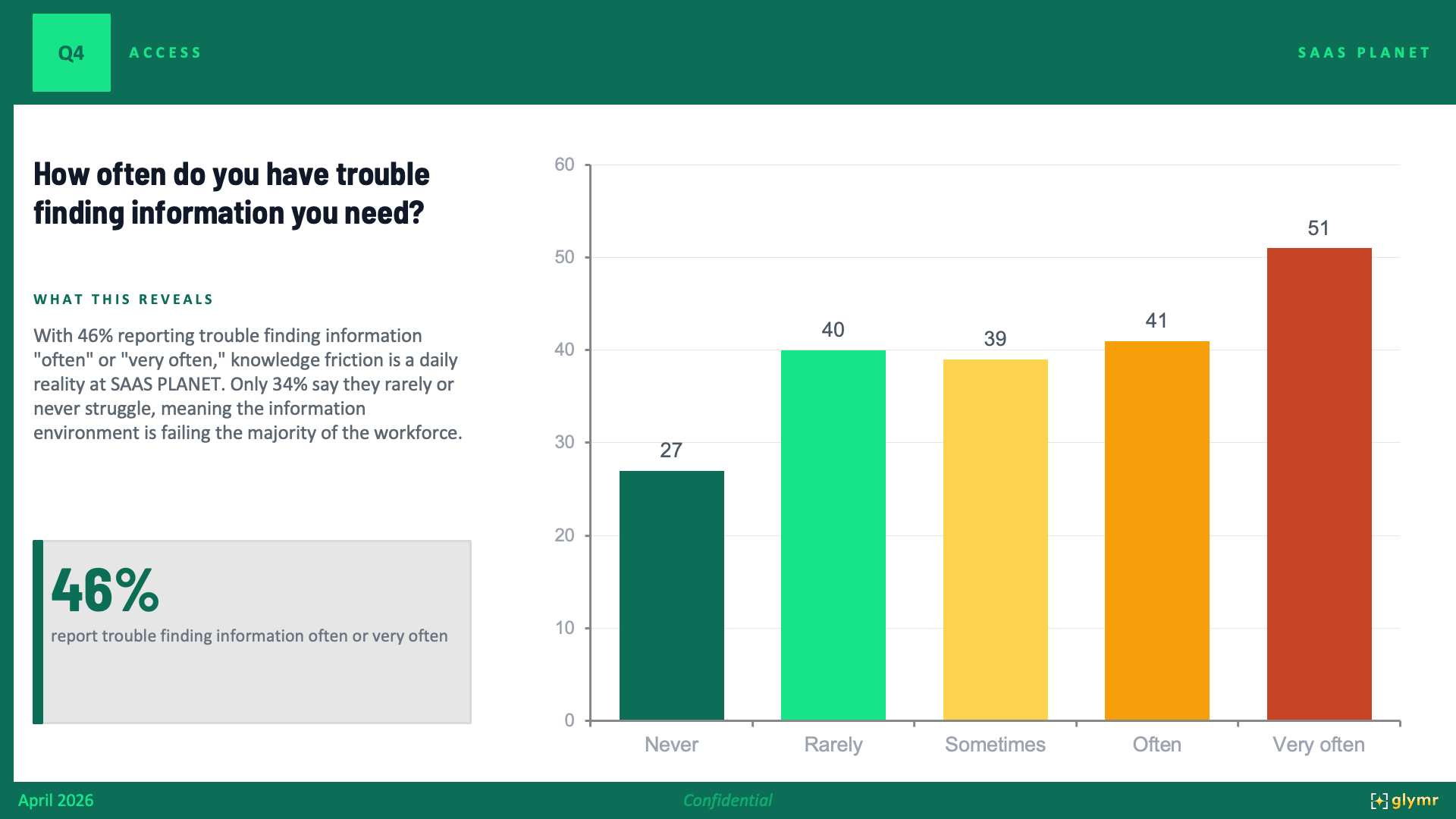
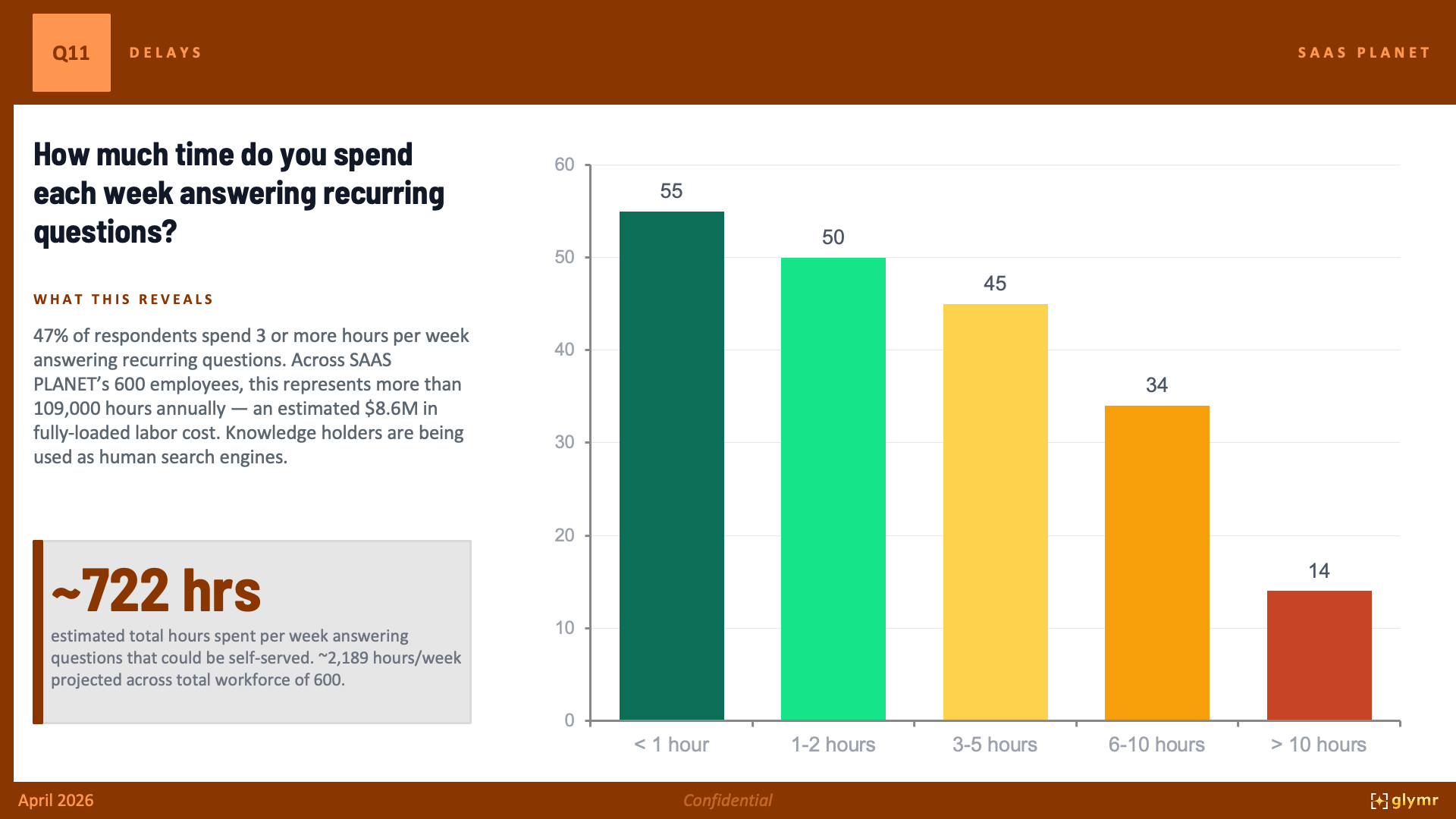
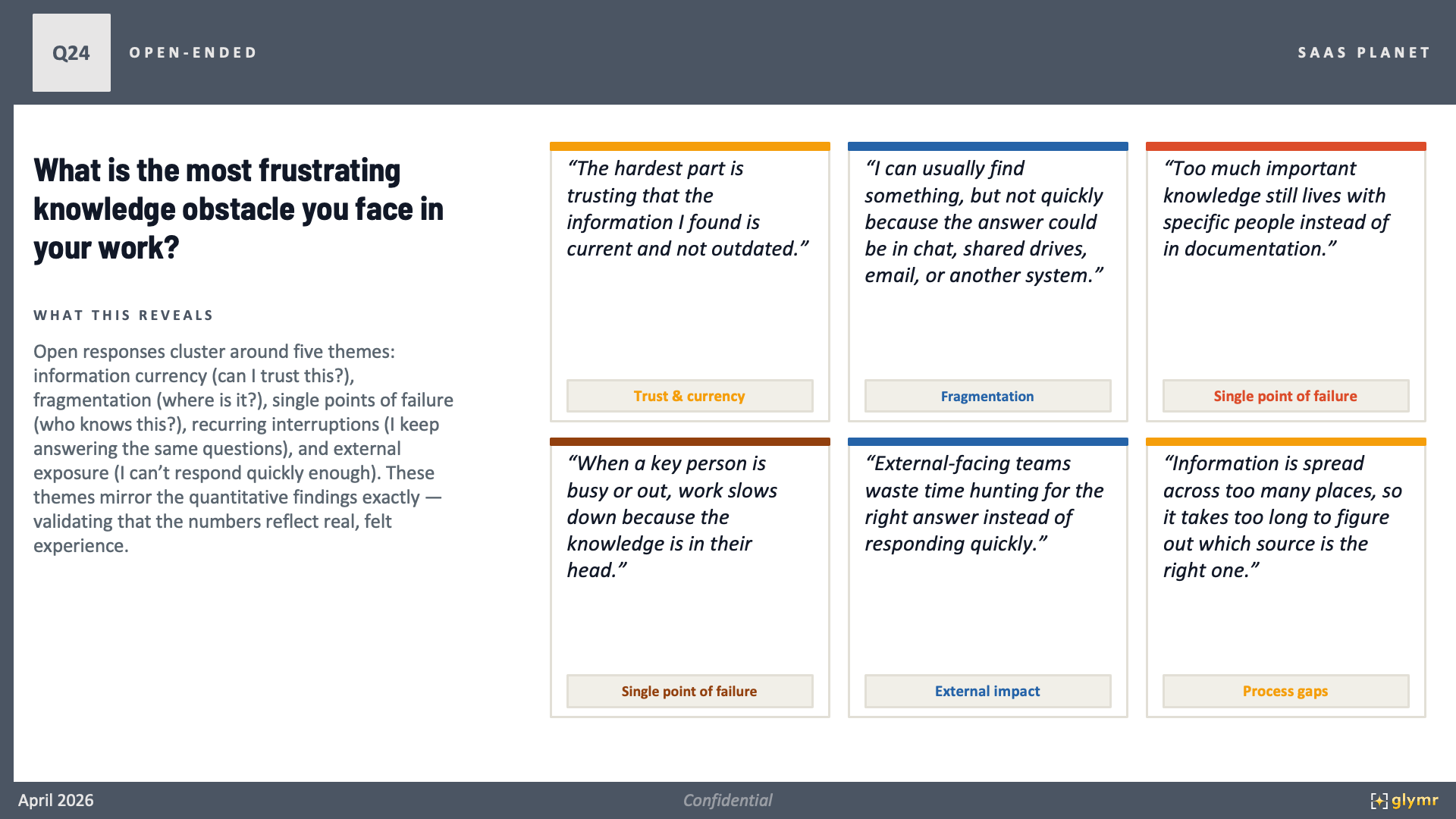
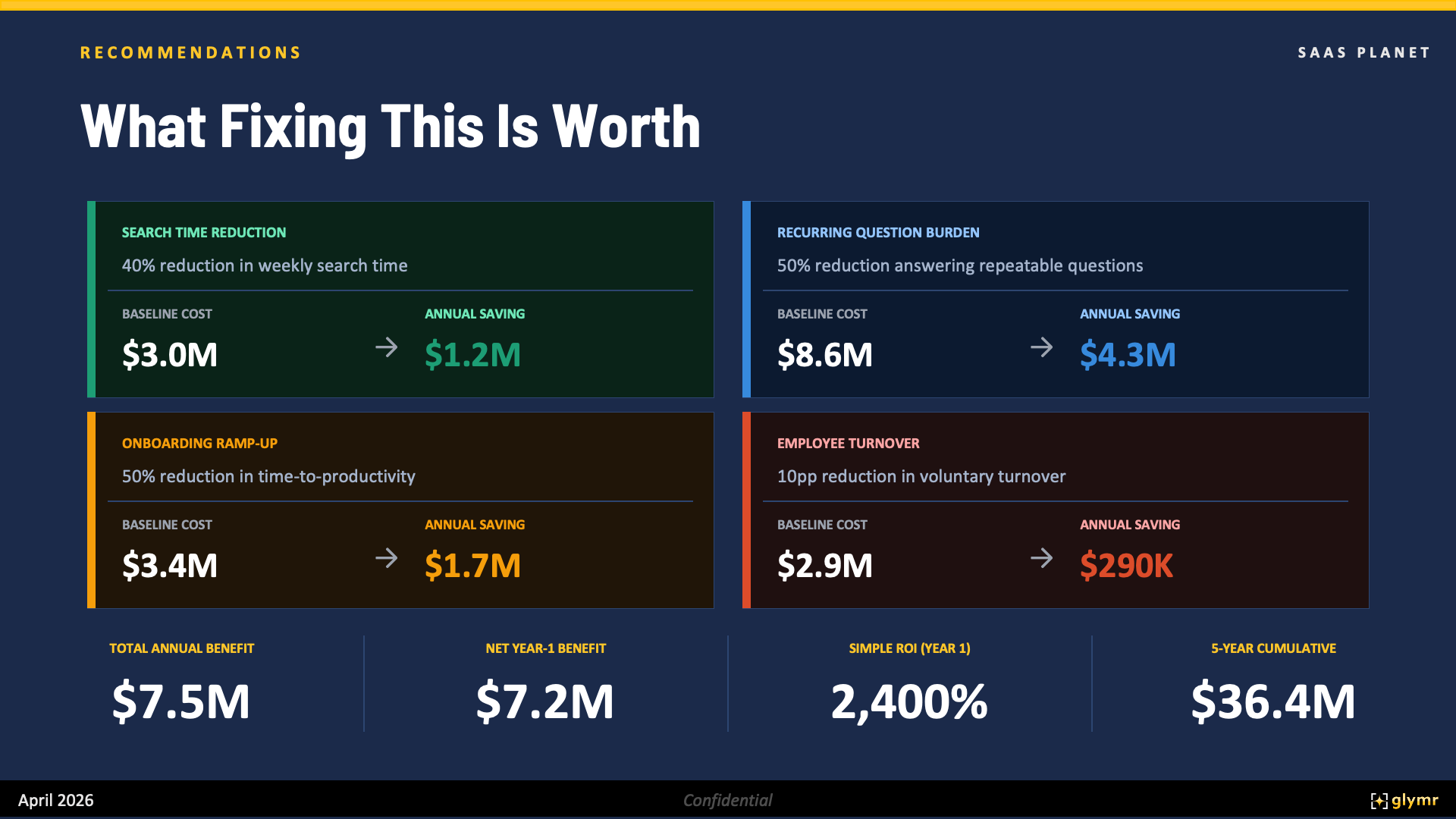
Pages shown are based on simulated data for a fictional company.
Involvement
Low Commitment, Light Lift, Maximum Value
The assessment is built to run without pulling your organization off its work.
- About two weeks from launch to readout, depending on how quickly responses come in
- Roughly 10 minutes per employee to complete the survey
- 10–12 questions from you about the organization: headcount, locations, average salary, current onboarding time, and similar context
- Help getting the survey out (your HR team sends it, or you give us a list) plus a reminder or two while it runs
- One to two hours from you and your leadership team for the readout
Fixed fee, agreed before we start. There is no discovery phase to fund, no open-ended scope, and no team of consultants on site for a month.
Who This Is For
The Knowledge Friction Assessment is most valuable when:
- New employees are still asking basic process questions 60 or 90 days in, and no one can say what that ramp is costing.
- A few people are interrupted constantly for answers that should be findable elsewhere, and their availability has become everyone else's bottleneck.
- Work gets rebuilt (analysis, documents, decisions) because no one knew it already existed.
- The same process runs differently across teams, sites, or individuals, and the variation is starting to surface as rework, quality problems, or compliance exposure.
- Leadership knows a key departure would hurt but cannot say how disruptive such a loss would be.
- You are preparing to put organizational knowledge in front of AI tools and want to know how much of it is currently fragmented, undocumented, or out of date.
If you already know where the friction is and what it is costing you, you may be ready to skip ahead to a Knowledge Management Program. The assessment is for when you can feel the drag but cannot yet put a number or a priority order on it.
"I would definitely say the assessment exceeded my expectations in giving a realistic baseline on our knowledge management and pointed out ways we could greatly improve our productivity."
Find out where knowledge friction is costing you the most.
About two weeks from launch to readout, roughly 10 minutes per employee, and a quantified, prioritized picture of where your organization is losing time and operating capacity.