Your most valuable people shouldn't also be your biggest bottleneck.
When a handful of experts are the only path to an answer, the business's growth is capped by their availability, and their departure becomes a real operational risk.
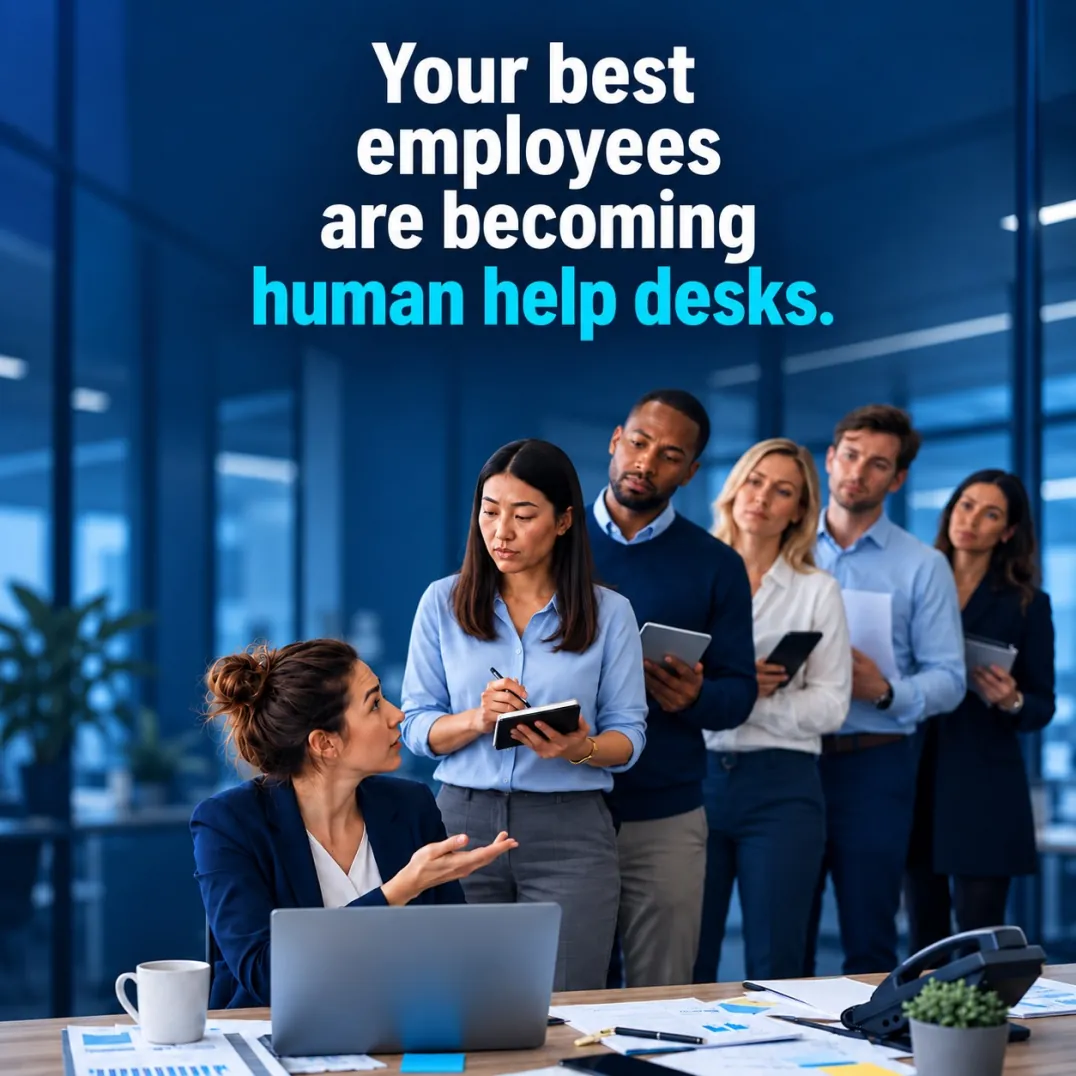
An expert bottleneck forms when a small number of senior employees or specialists become the default source for questions, decisions, or troubleshooting that should be answerable elsewhere. It slows the business down, limits how much those experts can focus on higher-value work, and concentrates risk in a few people.
What Causes Expert Bottlenecks?
Expert bottlenecks form for a good reason: someone became genuinely excellent at their job, and over time, became the fastest path to a correct answer. Colleagues learn to route questions to them instead of looking things up, because it's faster and more reliable. That habit scales badly. As the organization grows, more people rely on the same few experts, and the experts spend more of their time answering repeated questions instead of doing the work only they can do.
Common Symptoms
- Senior people spend hours each week answering questions that shouldn't require their involvement.
- Certain employees have become effectively indispensable: their absence would stall real work.
- New hires are told to "just ask [name]" instead of being pointed to documented guidance.
- The same questions get asked repeatedly because there's no trusted place to find the answer without asking a person.
- The organization's capacity is quietly capped by how many hours a handful of experts have in a day.
After a few weeks on the job, a new hire asked how to get access to "the Mickey system."
A client in the early stages of planning a knowledge management program brought a new employee onto the team. In meeting after meeting, the new hire heard Mickey referenced in the context of critical functions: the place answers came from, the thing work had to go through.
Eventually they asked a VP how to get access to the Mickey system. The VP laughed and explained that Mickey wasn't a system. Mickey was a person: an employee who had been there for decades and was the main expert on an entire business function.
Everyone who had been there a while had stopped hearing it. To someone new, an expert bottleneck was indistinguishable from a system.
Glymr client story (anonymized); company and identifying details withheldWhy It Matters
Expert bottlenecks limit growth and create concentrated risk at the same time. Every hour an expert spends re-answering a solved question is an hour not spent on the work that actually requires their judgment. And because that expertise usually isn't written down anywhere, the bottleneck also becomes a critical-knowledge-risk problem: if that person is out, transitions to a new role, or leaves, the organization loses access to knowledge it never captured.
How Glymr Helps
Glymr's Knowledge Friction Assessment identifies where expert bottlenecks are costing the organization the most time and where the risk is highest. From there, Critical Knowledge Capture documents the expertise, exceptions, and decision logic a bottlenecked expert carries, while they are still in the role, and builds it into a Knowledge Management Program that gives other employees, and AI tools, a trustworthy place to find the answer, so the expert isn't the only path to it.
What Fixing This Looks Like
40% more tickets closed per day, 20% higher first-call resolution.
CrushBank reports that making senior engineers' collective knowledge available to frontline support increased tickets closed per day by 40%, improved first-call resolution by 20%, and reduced the need for escalation.
IBM Case Study, CrushBankSeller research time fell from four hours to 15 minutes.
Lumen reduced seller research time from about four hours to 15 minutes using AI-assisted access to account and market knowledge. Its CRO estimated the reclaimed seller capacity could be worth approximately $50 million in revenue over 12 months.
Microsoft Customer Story, Lumen TechnologiesDemo wait time fell from 21 days to zero.
Visma | Raet reported that prospects were waiting three weeks or more for solution-consultant availability. Making repeatable product expertise available on demand eliminated that demo delay and returned more than 20 hours a week to the presales team.
Consensus Customer Story, Visma | RaetRelated Reading
Expert bottlenecks and operational inconsistency are closely linked: both come from knowledge that lives in people's heads instead of a documented, shared source.
Find out how much of your experts' time is going to questions they should not be answering.
A Knowledge Friction Assessment quantifies the repeated-question burden, identifies which experts have become load-bearing, and prioritizes what to capture first.
Frequently Asked Questions
Why do subject matter experts become bottlenecks?
Because they became genuinely excellent at their job and, over time, the fastest path to a correct answer, so colleagues learn to route questions to them instead of looking things up. That habit scales badly: as the organization grows, more people rely on the same few experts, who spend more of their time re-answering questions instead of doing the work only they can do.
How do you reduce repeated questions to senior employees?
By capturing the expertise, exceptions, and decision logic those experts carry and building it into a place other employees, and AI tools, can find it themselves, so the expert is not the only path to the answer. Glymr's Knowledge Friction Assessment identifies where this is costing the most time before that capture work begins.
How can companies capture tacit expert knowledge?
By treating it as a defined piece of work rather than something that happens informally, identifying which experts carry the most undocumented knowledge, capturing their expertise and decision logic directly through Critical Knowledge Capture, and building it into a Knowledge Management Program so it stays usable and current after capture.
Is an expert bottleneck also a critical knowledge risk?
Usually, yes. Because a bottlenecked expert's knowledge typically is not written down anywhere, the bottleneck is also a critical knowledge risk problem: if that person is out, changes roles, or leaves, the organization loses access to knowledge it never captured.