How exposed is your organization to hidden knowledge loss?
A two-minute self-check for leaders. Ten statements, a score out of 50, and a straight answer about whether this is a problem worth investigating.
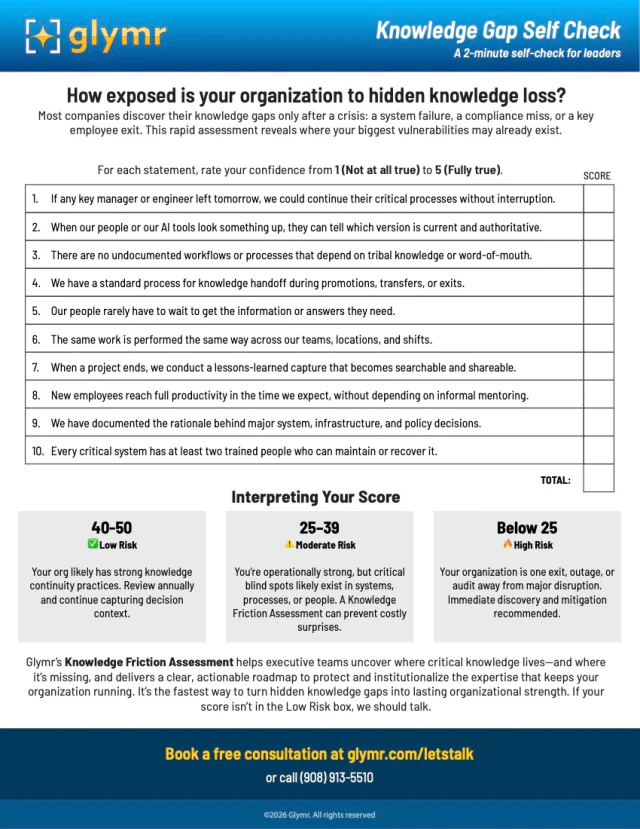
Most companies discover their knowledge gaps only after a crisis: a system failure, a compliance miss, or a key employee walking out with two decades of operating context. This is a way to find out first.
What It Asks About
Ten statements, each rated from 1 (not at all true) to 5 (fully true), covering four things that determine whether an organization keeps operating when a person, a system, or a process changes:
- Continuity. Whether critical work survives a departure, and whether anyone else could pick it up
- Trustworthy knowledge. Whether your people, and your AI tools, can tell what is current and authoritative rather than guessing between versions
- Transitions. Whether knowledge is handed off deliberately during promotions, transfers, and exits, or reconstructed afterward
- Consistency and ramp. Whether the same work is done the same way across teams and locations, and whether new people get productive without informal mentoring
Add the ten ratings together and the total places you in one of three bands. Above 40 suggests solid continuity practices. Below 25 means the organization is roughly one exit, outage, or audit away from real disruption.
Use It on More Than Yourself
The score you give your own organization is useful. The more revealing exercise is having three or four of your leadership team complete it independently, before anyone compares notes.
Different executives see different parts of the organization. A CEO judges it through what reaches leadership, a COO through what breaks in execution, a CIO through what the systems expose. When they score the same ten statements, three patterns tend to emerge, and each one tells you something:
- You agree and the score is high. Reasonable confidence that continuity is genuinely handled.
- You agree and the score is low. The most actionable outcome: a shared, acknowledged problem with nobody left to convince.
- You disagree sharply on specific statements. Usually the most important finding. A statement where the CEO scores 4 and the COO scores 2 is one where nobody actually knows the answer, and that gap is itself the risk.
That third pattern is why the self-check is built as a one-page handout rather than something you fill in alone.
Where a Self-Check Stops
It measures what leadership believes to be true. That is worth knowing, and it is not the same as what employees experience day to day. The distance between those two is often the finding that matters most.
A Knowledge Friction Assessment closes that distance by asking your employees directly. It quantifies where friction is worst, what it is costing, and what to address first (about two weeks from launch to readout, with roughly 10 minutes of each employee's time).
Where the exposure is concentrated in one or two people rather than spread across the organization, Knowledge Exit Interviews and Executive Knowledge Transfer capture what they carry before it leaves with them.
Related Reading
8 Signs You Need Knowledge Management covers what each of these problems looks like day to day, and what each one quietly costs. If your lowest ratings were on whether people and AI tools can tell what is current and authoritative, How to Build a Knowledge Governance Model covers the ownership and review routines that fix it.
Find out whether your company's knowledge is usable by the people and AI systems that need it.
A Knowledge Friction Assessment or AI Effectiveness Assessment gives you a clear, quantified picture of where your organization is losing time, money, and AI value, and what to do about it.